Neurotech skills for Claude Code
32 skills and 6 agents that give Claude the established workflows of neural engineering: BCI decoding, EEG/MEG and spike analysis, real-time rigs, brain stimulation and neural devices. Free and open source under the MIT licence.
View on GitHubInstall the Claude Code plugin
/plugin marketplace add Hillock-NeuroTech/ultimate-neurotech-claude-skills
/plugin install neuro-router@hillock
Then add the bundles you work with, for example /plugin install neuro-decoding@hillock. Skills load automatically when a request matches.
What it catches
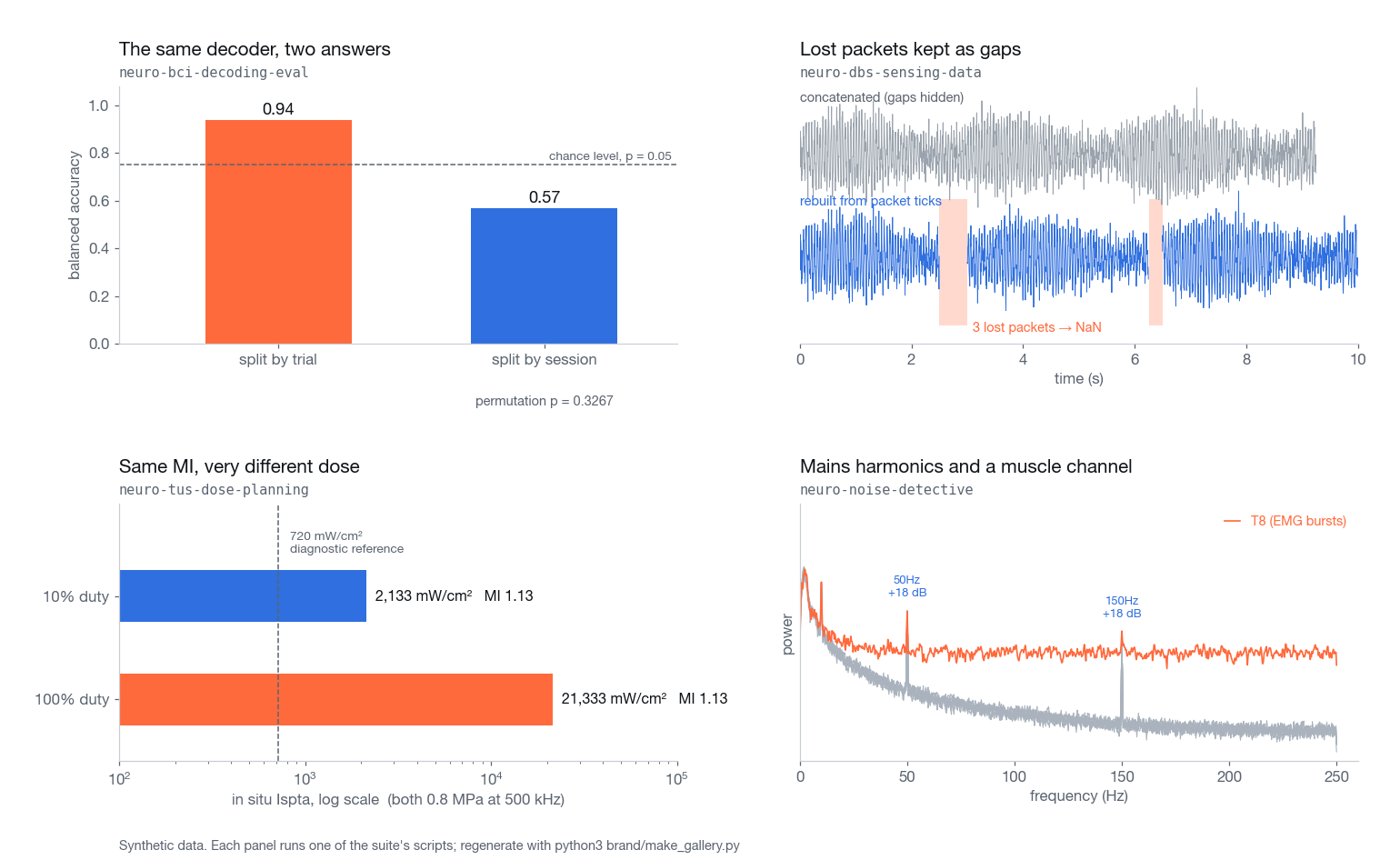
The same decoder scores 0.94 when EEG trials are split at random and 0.57, below chance, when whole recording sessions are held out. With Hillock loaded, Claude evaluates decoders with session- and subject-wise splits, true chance levels and permutation tests by default.
Skill bundles
neuro-router
Entry point that maps any neurotech request to the right workflow; reading every neural file format (EDF, BrainVision, XDF, NWB, Neuralynx, Blackrock, Intan, Open Ephys, SpikeGLX and more); finding public EEG, MEG, iEEG and spike datasets.
neuro-decoding
- Leak-free BCI and neural decoding evaluation
- Intracortical BCI decoder stability across days
- Known quirks of public BCI datasets
- Seizure detection and sleep staging evaluation
- Comparing EEG foundation models fairly
neuro-signal
- EEG/MEG preprocessing review (MNE-Python, EEGLAB, FieldTrip, Brainstorm)
- Spike sorting quality control (SpikeInterface, Kilosort 4, Neuropixels)
- Diagnosing line noise, muscle and drift
- Channel map verification
- Connectivity claims and cluster-based permutation statistics
neuro-realtime
- Real-time BCI pipelines (Lab Streaming Layer, BrainFlow, MNE-LSL)
- Clock synchronisation between devices
- Stimulus timing audits (PsychoPy, Psychtoolbox, photodiodes)
- Phase-locked stimulation and stimulation artifact recovery
- Porting decoders and filters to fixed-point firmware
neuro-stim
- Electrical stimulation safety: charge density, Shannon k, electrode limits
- TMS and tDCS field modelling (SimNIBS, ROAST)
- Deep brain stimulation sensing data (Medtronic Percept, Lead-DBS)
- Transcranial focused ultrasound dose planning (k-Wave, BabelBrain, ITRUSST)
- Peripheral nerve stimulation models (NEURON, ASCENT)
- Sham and blinding design
neuro-device
- Biopotential front-end design (ADS1299, Intan RHD2000)
- Electrode electrochemistry: impedance spectroscopy, CSC, voltage transients
- Implant power and thermal budgets
- FDA regulatory pathways and databases
- IEC 62304 software inventory and vulnerability checks
Tested scripts and a benchmark
17 Python scripts do the standard calculations, each tested against cases with known answers: leak-free decoder evaluation, clock alignment, LSL stream checks, stimulation charge and density, ultrasound safety indices, Percept stream rebuilds, noise budgets, impedance fitting, FDA and vulnerability lookups. A 46-task benchmark, graded by code, checks any AI assistant on the mistakes these workflows prevent.
Stimulation and device workflows are research and engineering support, not clinical decisions, regulatory sign-off or certification. Built by Hillock Labs. Corrections and reviews from practitioners are welcome on GitHub.